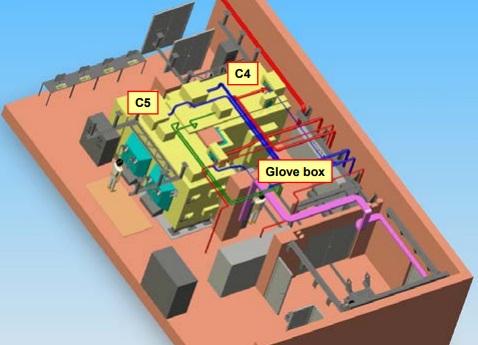
Facility Details: VERDON

Organization / Localization: CEA Cadarache
Country: France
Facility Status: Closed
VERDON
Focus area 1: Fission product release (including in-vessel, ex-vessel) (7)
Facility Description: A testing facility to investigate fission products release from nuclear fuels
Test Identification: VERDON 1
SA-Related Topics / Phenomena:
Measured Parameters: Release kinetics, Microstructure and chemical characterization of the solid sample
Modelling: 1-1.5 bar; from RT to 2600°C; H2; irradiated (72 GWd/t) and re-irradiated UO2 fuel
Simulation Code: "MELCOR/GEMS & HERACLES ALCYONE ASTEC V2.2 MAVR-TA Thermo-Calc/TAF-ID"
Experimental Research Program: VERDON
Link to PIRT: WP-1.5 ST-3, ST-5
Show/Hide Additional Details ▼
References: "[1] Y. Pontillon et al., « International Source Term Program - VERDON-1 test: Fission product release from High Burn Up UO2 fuel in severe accident conditions. Final Report », CEA-DEN-CAD-DEC-SA3C-LAMIR NT, vol. 12‑013, déc. 2012
[2] E. Geiger et al., « Modelling nuclear fuel behaviour with TAF-ID: Calculations on the VERDON-1 experiment, representative of a nuclear severe accident », Journal of Nuclear Materials, vol. 522, p. 294‑310, août 2019, doi: 10.1016/j.jnucmat.2019.05.027.
[3] E. Geiger et al., « Fission products and nuclear fuel behaviour under severe accident conditions part 2: Fuel behaviour in the VERDON-1 sample », Journal of Nuclear Materials, vol. 495, p. 49‑57, nov. 2017, doi: 10.1016/j.jnucmat.2017.08.002
[4] S. Nichenko et al., «Modelling of fission products release in VERDON-1 experiment with cGEMS: Coupling of severe accident code MELCOR with GEMS thermodynamic modelling package», Annals of Nuclear Energy, vol. 152, p. 107972, 2021, doi.org/10.1016/j.anucene.2020.107972
[5] A. Germain et al., «Modeling of fission product release during severe accidents with the fuel performance code ALCYONE», Nuclear Engineering and Design, vol. 393,
p. 111778, 2022, https://doi.org/10.1016/j.nucengdes.2022.111778.
[6] P. Chatelard et al., «ASTEC V2.2 code validation: Illustrative results and main outcomes», Nuclear Engineering and Design, vol. 413, p. 112547, 2023, https://doi.org/10.1016/j.nucengdes.2023.112547.
[7] Yu.B. Shmelkov et al., «Development and validation of the MAVR-TA code for analyzing the release and transport of fission products during a severe accident at a nuclear power plant with VVER. Part 1 –Release of fission products from a fuel», Nuclear Engineering and Design, vol. 385, p. 111407, 2021, https://doi.org/10.1016/j.nucengdes.2021.111407.
[8] E. Geiger et al., «Modelling nuclear fuel behaviour with TAF-ID: Calculations on the VERDON-1 experiment, representative of a nuclear severe accident», Journal of Nuclear Materials, vol. 522, p. 294-310, 2019, https://doi.org/10.1016/j.jnucmat.2019.05.027"
Contributed By: Y. Pontillon
Facility Description: A testing facility to investigate fission products release from nuclear fuels
Test Identification: VERDON 1 - 1500°C - Geiger PhD
SA-Related Topics / Phenomena:
Measured Parameters: Microstructure and chemical characterization of the solid sample
Modelling: From RT to 1500°C under Ar + 4% H2. Sample identical to VERDON 1 sample (same father fuel rod)
Simulation Code: ASTEC
Experimental Research Program: VERDON (ISTP)
Link to PIRT: WP-1.5 ST-3, ST-4, ST-5
Show/Hide Additional Details ▼
References: [1] E. Geiger, PhD thesis
Comments: Characterization by EPMA
Contributed By: Y. Pontillon
Facility Description: A testing facility to investigate fission products release from nuclear fuels
Test Identification: VERDON 2
SA-Related Topics / Phenomena:
Measured Parameters: Release kinetics, Transport kinetics
Modelling: 1-1.5 bar; from RT to 2100°C; air; irradiated (55 GWd/t) and re-irradiated MOX fuel
Simulation Code: ASTEC V2.2 MAVR-TA VICTORIA
Experimental Research Program: VERDON
Link to PIRT: WP-1.5 ST-5
Show/Hide Additional Details ▼
References: [1] A. GallaisDuring et al., «Overview of the VERDON-ISTP Program and main insights from the VERDON-2 air ingress test», Annals of Nuclear Energy, Volume 101, March 2017, Pages 109-117, https://doi.org/10.1016/j.anucene.2016.09.045
[2] P. Chatelard, L. Laborde, «ASTEC V2.2 code validation: Illustrative results and main outcomes», Nuclear Engineering and Design, vol. 413, p. 112547, 2023, https://doi.org/10.1016/j.nucengdes.2023.112547.
[3] Yu.B. Shmelkov et al., «Development and validation of the MAVR-TA code for analyzing the release and transport of fission products during a severe accident at a nuclear power plant with VVER. Part 1 –Release of fission products from a fuel», Nuclear Engineering and Design, vol. 385, p. 111407, 2021, https://doi.org/10.1016/j.nucengdes.2021.111407.
[4] H. Shiotsu et al., «Numerical analysis for FP speciation in VERDON-2 experiment: Chemical re-vaporization of iodine in air ingress condition», Annals of Nuclear Energy, vol. 163, p. 108587, 2021, https://doi.org/10.1016/j.anucene.2021.108587.
Comments: Transport of FP (TGTM)
Contributed By: Y. Pontillon
Facility Description: A testing facility to investigate fission products release from nuclear fuels
Test Identification: VERDON 2, 3, 4
SA-Related Topics / Phenomena: High-burnup and MOX FP release characteristic (Intact geometry) ( Also relevant for advanced designs )
Measured Parameters: Release kinetics
Modelling: cf lines 8-10
Simulation Code: ASTEC, AC2, MELCOR
Experimental Research Program: VERDON (ISTP)
Link to PIRT: WP-1.5 ST-2
Show/Hide Additional Details ▼
References: "[1] C. Le Gall et al., «MOX fuel microstructural evolution during the VERDON-3 and 4 tests», Journal of Nuclear Materials, vol. 531, p. 152015, avr. 2020, doi: 10.1016/j.jnucmat.2020.152015
[2] C. Le Gall et al., «Fission product speciation in the VERDON-3 and VERDON-4 MOX fuels samples», Journal of Nuclear Materials, Volume 530, March 2020, 151948, https://doi.org/10.1016/j.jnucmat.2019.151948"

Contributed By: F. Audubert
Facility Description: A testing facility to investigate fission products release from nuclear fuels
Test Identification: VERDON 3
SA-Related Topics / Phenomena:
Measured Parameters: Release kinetics,Microstructure and chemical characterization of the solid sample
Modelling: 1-1.5 bar; from RT to 2300°C; steam; irradiated (55 GWd/t) and re-irradiated MOX fuel
Simulation Code: Not found
Experimental Research Program: VERDON (ISTP)
Link to PIRT: WP-1.5 ST-5
Show/Hide Additional Details ▼
References: [1] C. Le Gall et al., « MOX fuel microstructural evolution during the VERDON-3 and 4 tests », Journal of Nuclear Materials, vol. 531, p. 152015, avr. 2020, doi: 10.1016/j.jnucmat.2020.152015.
Contributed By: Y. Pontillon, F. Audubert
Facility Description: A testing facility to investigate fission products release from nuclear fuels
Test Identification: VERDON 4
SA-Related Topics / Phenomena:
Measured Parameters: Release kinetics, Microstructure and chemical characterization of the solid sample
Modelling: 1-1.5 bar; from RT to 2530°C; H2; irradiated (55 GWd/t) and re-irradiated MOX fuel
Simulation Code: Not found
Experimental Research Program: VERDON (ISTP)
Link to PIRT: WP-1.5 ST-5
Show/Hide Additional Details ▼
References: [1] C. Le Gall et al., « MOX fuel microstructural evolution during the VERDON-3 and 4 tests », Journal of Nuclear Materials, vol. 531, p. 152015, avr. 2020, doi: 10.1016/j.jnucmat.2020.152015.
Contributed By: Y. Pontillon, F. Audubert
Facility Description: A testing facility to investigate fission products release from nuclear fuels
Test Identification: VERDON 5
SA-Related Topics / Phenomena:
Measured Parameters: Release kinetics, Transport kinetics
Modelling: 1-1.5 bar; from RT to 2000°C; air + boric acid; irradiated (68 GWd/t) and re-irradiated UO2 fuel
Simulation Code: Not found
Experimental Research Program: VERDON (CEA-JAEA contract)
Link to PIRT: WP-1.5 ST-5
Show/Hide Additional Details ▼
Comments: Transport of FP (TGTM)
Contributed By: Y. Pontillon


Implemented as part of the Seaknot EU funded project (HORIZON-EURATOM-2021-NRT-01 under Grant Agreement No. 101060327) - WP2.6 UNIPI (2024-2026)